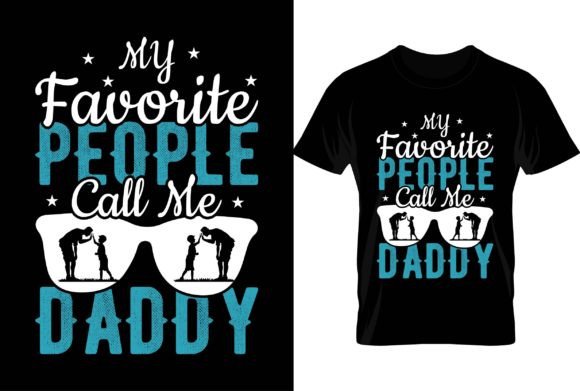
My Favorite People Call Me Daddy...Tee Review
As a designer who has spent years navigating the intersection of digital art and physical stitching, I approach every new asset with a critical eye. The market is flooded with generic graphics, but occasionally, a design arrives that strikes a chord for specific, high-demand niches. My Favorite People Call Me Daddy...Tee is one such piece. At first glance, it presents as a bold statement within the realm of T-Shirt Designs, but its utility extends far beyond simple screen printing. When evaluating this Graphics file for real-world application, the immediate impression is one of playful confidence. The typography is assertive, and the layout suggests a design meant to be seen from a distance, making it an ideal candidate for custom apparel where personality needs to shine through.
The Visual Weight and Embroidery Potential
Before I even load the files into my digitizing software, I analyze the vector structure. The product description notes that this design is made with 100% vector shapes and is fully editable. For an embroidery designer, this is music to our ears. It means we are not stuck with a rigid image; we can adjust line weights to accommodate different stitch densities or modify the kerning to fit a smaller hoop size without losing legibility. The high resolution of the source files (4500×5400 at 300 dpi) ensures that when I preview the design on a mockup, the edges remain crisp, giving me confidence in how the final finished product will look.
However, the transition from a digital machine embroidery design to a stitched reality requires careful planning. The phrase "My Favorite People Call Me Daddy" carries a significant amount of text. In embroidery, long lines of text can become a nightmare if the stitch density is too high or the font is too thin. My instinct is to treat this as a heavy fill-stitch project rather than a delicate running stitch piece. The visual weight of the text demands a robust satin stitch or a dense fill to ensure the letters stand out against the fabric texture. If you plan to use this for a sweatshirt embroidery project, the bulk of the fabric will support the thread well, but on a thin t-shirt, you must be vigilant about using the correct stabilizer to prevent puckering.
A Real-World Scenario: The Boutique Tote Bag Project
Let’s imagine a practical scenario. You run a small craft business on Etsy, and you’ve decided to create a line of personalized gifts for Father’s Day. You want to offer a premium embroidered tote bag design. My Favorite People Call Me Daddy...Tee fits perfectly here. Unlike a standard print, embroidery adds a tactile quality that elevates the perceived value of a handmade product. Imagine a sturdy canvas tote bag, perhaps in a neutral beige or deep navy, with this phrase stitched in a contrasting white or gold thread. The texture of the canvas complements the raised nature of the embroidery, creating a luxurious feel that flat printing simply cannot achieve.
In this context, the design becomes more than just a slogan; it becomes a conversation starter. Customers looking for unique personalized gift options often seek items that feel bespoke. By offering this design on a tote bag, you are tapping into the desire for functional fashion with a humorous twist. However, the success of this project hinges on execution. If the stitch count is too low, the letters might look jagged. If it is too high, the canvas could warp. This is why testing the design on scrap fabric is non-negotiable. You need to see how the thread interacts with the specific weave of your tote material before committing to a full production run.
Navigating Fabric Challenges and Hoop Constraints
While the versatility of this design is impressive, there are limitations that every professional embroiderer must respect. The length of the phrase makes it less suitable for very small hoop sizes. If you are attempting to fit this onto a cap or a small baby item, you will likely need to break the text into multiple lines or significantly reduce the font size, which risks legibility. On curved surfaces like caps, the tension required for a long, continuous line of text can cause the fabric to pucker, distorting the message. Therefore, I would recommend reserving My Favorite People Call Me Daddy...Tee for flatter surfaces like chest pockets, sweatshirts, aprons, or pillow covers where the machine head can move freely without distortion.
Fabric choice is equally critical. Textured fabrics like fleece or heavy denim work wonders for this type of bold text because the stitches sink slightly into the pile, hiding minor imperfections. Conversely, on smooth, dark fabrics, the contrast is key. If you are working with a black garment, you must ensure your thread colors pop. A light gray thread might get lost in the shadows of the fabric weave. Always test your color combinations on a swatch of the actual fabric you intend to sell. Furthermore, if you are targeting the holiday embroidery market, consider how the design looks on seasonal fabrics. A festive red or green background could make this a perfect holiday gift, provided the thread color offers enough contrast.
Commercial Viability and Brand Consistency
For the savvy Etsy seller or boutique owner, consistency is the backbone of a trusted brand. Using a high-quality, fully editable digital embroidery file like this one allows you to maintain that consistency across different products. Whether you are selling a sweatshirt, a kitchen towel, or an embroidered patch, the core identity of the design remains intact. This uniformity builds customer trust. When a buyer sees your logo or style on a tote bag and then recognizes it on a pillow cover, they associate that quality with your shop name.
However, you must also consider the commercial implications. While the file comes with formats like PDF, EPS, SVG, JPEG, and PNG, these are primarily for viewing or printing. To use this for actual stitching, you need to ensure you have the rights to convert these vectors into a stitch file format compatible with your machine. The description mentions the files are fully editable, which is excellent for customization, but always double-check the licensing terms before selling finished items. Some designers allow personal use only, while others grant commercial licenses for the finished product. Never assume; verify the license to protect your business from legal issues.
Final Thoughts on Execution and Value
My Favorite People Call Me Daddy...Tee is a strong contender for any portfolio focused on humor and bold statements. Its strength lies in its adaptability and the emotional connection it creates with the wearer. As a designer, I appreciate the clean vector lines that make digitization straightforward, allowing me to focus on the nuances of stitch direction and pull compensation. But remember, a great design is only as good as the execution. Take the time to test your settings, choose the right stabilizer, and select thread colors that enhance the message rather than compete with it.
If you are looking to expand your custom apparel offerings or add a touch of wit to your small shop product line, this design offers a solid foundation. It works beautifully on larger garments and accessories where the text can breathe. Just be mindful of the limitations regarding small hoops and delicate fabrics. With proper preparation and attention to detail, this embroidery project can become a best-seller in your catalog, delighting customers with its charm and professional finish. Ultimately, the goal is to create a product that feels personal, durable, and undeniably stylish, and this design has all the potential to deliver exactly that.